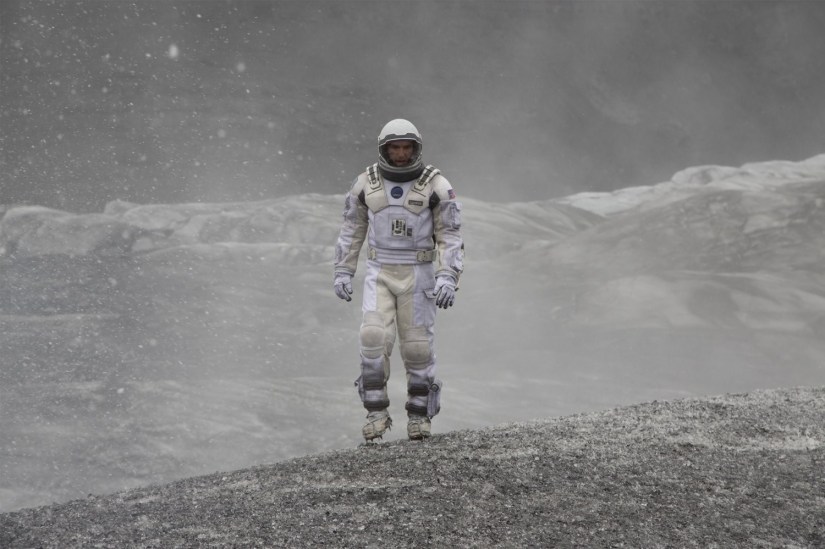
With Christopher Nolan’s latest sci-fi epic, his own unique style is evident from the very first scenes. Interstellar follows Nolan’s conventions of entertaining the lie at the center of a film in order to bring about truth while at the same time further exploring new ideas. With his latest, there is not just one lie; a multitude of characters deceive others for the betterment of humanity. Some characters see mankind as a whole, while the struggle for others comes down to their own personal affairs. Viewing humanity on a broad scale and switching to a narrow scope brings about a bridge between these two: Relationships and the emotions that follow; namely, love and family. Ultimately, Nolan contrasts love and family directly with deceit seen in this motion picture.
It is important to note the root of this discourse: Todd McGowan and his book, The Fictional Christopher Nolan. This is intended as a continuation of sorts, and an application of McGowan’s base ideas to Christopher Nolan’s latest film.
As pointed out by McGowan, the audience is deceived and led on in many of Nolan’s other films, even within minutes of the film’s onset. Interstellar is no different. The viewer is made to assume that the Dust Bowl is the topic of discussion. However, with a Nolan movie, the ending gives a twist; Murphy all grown up was the one talking in the beginning. It was not the Dust Bowl but the blight and dust storms that she was talking about. This mirrors what Nolan does throughout his works. Because of Nolan’s narrative style, the audience is in the dark and must figure out the scenario. This holds true with Memento, The Prestige, Inception, and even Batman Begins. All of these contain tricky, manipulative narratives. Whether it is flashbacks or simultaneous action scenes, the plot is purposefully out of order. Again, Interstellar is does not differ greatly. The beginning commences with narration, cutting to a flashback scene of Cooper’s crash, then to him waking up. Cooper’s dream has an effect on him even after he wakes, which is also no foreign notion to Nolan. This mixing and jumping around of scenes is meant not only to entertain and intrigue moviegoers but to confuse and tease them as well.
Deceit comes in many more forms throughout Interstellar. The first character dealing with it is unexpected and counterintuitive: old military robots. In film and modern literature, a robot generally takes one of two forms: a calculating, orderly, and machine-like entity. They follow orders blindly and without hesitation. They may be smart, but they cannot think critically. On the other hand there are mechanical agents that go rogue. Their artificial intelligence surpasses those of the creator and becomes the central issue. TARS, CASE, and KIPP are neither of these, yet none of them are all too similar. TARS seems to always have a quick-witted comment despite its humor setting constantly being lowered another level. CASE conversely says, “TARS talks plenty for both of us,” when asked why he is so quiet. This contrast in the machines’ “personalities” adds another layer to their character. They seem to have a growing form of intelligence that builds upon itself. But TARS has an honesty parameter of 90 percent, which means there is 10 percent of the time where he holds back information deemed unnecessary. How does TARS decide when this is, and what situation would this be necessary? Unless this artificial intelligence surpasses that of human’s intelligence, it should not be needed. Therefore human capabilities still surpass those of the AI’s. For example, manual docking, both initially, just after leaving Earth, and after Dr. Mann blows the hatch, are initiated and directed by humans rather than robots. Mann says it himself, “A machine doesn’t improvise well because you can’t program the fear of death.” Humans have the ability to give machines honesty levels, even a humor setting, but they have not completely created a sentient being. Cooper’s immediate reaction when Dr. Mann’s docking went wrong was to save the Endurance, no matter what. If it was up to TARS, it would not have happened: he even said it was not possible. It does not even matter whether this was the 90 percent of the ten percent honesty by TARS; the risk was higher than reward for his calculations.
Further on in the film’s plot these robots bring about deception again. KIPP – a clear reference to the astrophysicist consulted for the film (Kip Thorne) – gets little screen time, but that does not limit its importance. It is yet another tool for Nolan to play this deception game, but this time in a different manner. Dr. Mann uses KIPP to kill Romily so that he can escape the barren planet that has corrupted him. This is essentially the reverse form of deceit seen earlier. Rather than the robot conceal truth here, Mann uses the robot deceptively. Men have created these powerful, trusting (usually), and useful tools, but ultimately man can put them to use however they please. This is not one instance, but an idea that pervades the film. As stated by Cooper before entering the black hole, “He’s a robot…You don’t have to ask him to do anything.” Humans even have a sentimentality towards these robots at times. This spawns from the robots’ uniqueness from one another, creating an attachment humans have for them. Amelia Brand does not want to leave TARS behind because of this. Cooper’s command is the final word however, and he does what is necessary – he releases himself and TARS into the black hole. TARS, CASE, and KIPP are effectively at the disposal of the crew. It could be deceit in order to save oneself or it could be deceit for the betterment of a collective group. Regardless, the truth is withheld.
Deceit on an even larger scale follows: Professor Brand lied to nearly everyone going on this expedition. Plan A was a hoax; solving the equation had come to a halt and there was no way to get it to work. They needed more data in order to get the gravity problem solved. Professor Brand’s true plan was the population bomb that would continue all of humanity but desert the rest on earth. His view of mankind as a whole is noble in the sense that he is thinking of the greater good. For him, the lie is justified by the end effect. Based on his actions, Dr. Mann also follows this belief. However his lie comes from a different kind of motivation. For Mann, it is self- preservation, although he argues it is for the greater good of humanity. Brand, on the other hand, lies so that he can convince Cooper and the other astronauts to continue with the mission. In his mind, it is to save all of humanity as well, although it is not as warped of an idea as Dr. Mann’s. Dr. Mann even acknowledged he is a coward, and his selfishness leads to great destruction. This wreckage and confliction of ideas, mainly between Mann and Cooper, causes serious ramifications.
Despite the lie being a focal point and an essential plot device in Christopher Nolan’s films, Interstellar strays from this in some aspects. It begins with a foreshadowing by Brand. While on their way to Saturn, Cooper discusses nature with her, and how it cannot be evil. It is only harsh and unbiased. The only evil they have is what they take with them, Brand says. Fast forward to the second planet they visit, they encounter Dr. Mann, who contests Coop and his plans for the expedition. The only evil is that of Mann – clearly suggested by his name, this represents humanity as a whole. Therefore Dr. Mann is deceiving himself, which is further supported by the flawed logic of his argument. He nearly ruins the expedition in an attempt to save himself. Had Cooper not succeeded, he would have destroyed humanity by himself.
If Mann represents mankind, clearly Nolan is hinting at something. Subtlety may not be Nolan’s strong suit here, but that does not detract Brand’s foreshadowing early on. Ironically though, many characters made it a point that Mann was supposed to be “the best of them” and a courageous, daring explorer. But after he is introduced, suspicions immediately arise. How is this cold, desolate planet actually habitable? Cooper comes to find it is uninhabitable and Mann has acted selfishly in order to further his own agenda. Mann’s justification makes for an interesting commentary though; “The survival instinct. That’s what drove me […] It’s what’s gonna save us. Cause I’m gonna save all of us. For you, Cooper.” He wants to save humankind, but only if he is a part of it. Clouded by the fear death and inspired by Professor Brand’s poem, Mann acts accordingly. “Do not go gentle into that good night. Old age should burn and rave at close of day. Rage, rage against the dying of the light.” This rage refers to the survival instinct found only in humans, and only near death. With the hope that one of the dozen astronauts would find a habitable planet, humanity subconsciously relies on these explorers’ integrity. Who would suspect that one of the most renowned astronauts of their time would be driven to such deception? Only after Dr. Mann’s explanation could one sympathize with him.
Events on Miller’s planet also brought about philosophical discussions because of extreme, unprecedented circumstances. Love and protection are presented as a direct result of intense action sequences. While stuck waiting for the engines to drain after mistaking giant waves for mountains, Coop and Brand argue the ethics of leaving her behind. She wanted to sacrifice herself for the mission without even making an effort to save herself. Both angered by their waiting situation, they converse and Coop says, “When you become a parent, one thing becomes really clear. And that is that you want to make sure your children feel safe. And it rules out telling a ten year old that the world’s endin.” In hindsight, Coop sees that he left Murph in a state far from how he would have liked. His promise of returning appears to be deceitful as well. Until the close of the film, Coop’s pledge to come home seems futile. He can do nothing but attempt to get Plan A to work, but even that is impossible he soon finds out. Cooper also acts as a sentinel for the crew and for his family. He calls the shots and realizes what must be done during critical moments. His sacrifice of himself and TARS into the black hole for Brand proves his bravery and dedication to his promise.
Cooper’s protection of Murph may not seem very quantifiable, but it is heroic. He saw his promise through to Murph, despite returning on her deathbed. His love for Murph differs highly with that of Tom however. Cooper gives him a quick hug goodbye after a drawn out and highly emotional adieu to Murph. This lack of care for Tom during his childhood has a direct result on his adult life. It is clearly evident to see that he abandons all hope of his father’s return, whereas Murph clings on to the notion that there’s a chance he might return home one day. After a few hours on Miller’s time warped planet, Coop returns and over 20 years have passed on earth. Cooper’s reaction to Murph’s single message far outweighs that of Tom’s.
Although it is implicit, viewers see Coop’s love for Murph through his emotions. Copper breaks down numerous times because of the raw, overwhelming emotions. His confliction with leaving Murph leaves his tear ducts flowing like a faucet. Later on, after 23 years pass and Coop sees the messages, sadness sets in once more. Yet in neither of these instances is the idea of love so blatantly projected at the audience. It is not until later that love is explicitly dealt with. Brand argues “Love is the one thing we’re capable of perceiving that transcends time and space.” Because Nolan had been so subtle dealing with love up until this point, her monologue feels out of place. Cooper makes you feel emotion with his actions; Brand talks of love without any substance to back it up. This causes love to seem like another idea floated around which adds to the already dense and serious tone of the film. Had Brand not believed in this notion of love being all powerful and had her rant, nothing would have been lost in the rest of the film. Not only could this have been left out of the script, but doing so would have kept one of this film’s themes subtle and in-line with the previous mood of the film.
Once more love is trivialized when the film comes to a close. Murph is reunited with Cooper, after living her entire life essentially without him. Then after a few brief moments of talking with him, she tells him to go find Brand. What happened to Cooper’s love for Murph and her need for him as a father figure? “No parent should have to watch their own child die” she says. This idea of love briefly being touched on differs greatly than that of deception. Nolan leaves the audience in confusion on the topic of love but goes in depth when dealing with deception. Feeling like a last minute thought, love opposes the seriousness and importance that deceiving implies.
Family is explicitly referred to, just as love is. Dr. Mann’s argument is one surrounding the importance of family: Humans will give a boost of effort at the moment before death because of their family. Based on this, it is no wonder why Mann goes crazy; he has no family, along with all the other astronauts sent to through the wormhole. Therefore, it is also no coincidence that Coop, the only one with a family, is also the only explorer to make it back to the other side of the wormhole alive. As with love, Nolan attempts to dabble in the areas unknown to him when dealing with family.
To some moviegoers, Interstellar is exhilarating, confusing, and perplexing. Nolan deals with deception of humanity on a large scale and a small on as well. With much to be explained, it is a film with beautiful visuals and complex plot and narrative. This holds true for many others in the audience, but those with the context of Nolan’s filmography see obvious patterns: Deception of the audience and the characters’ deception as a useful plot device is a standout characteristic. This expertise in deception stands out and opposes those seemingly new concepts to Nolan: love and family.
 Filmify
You must be logged in to post a comment.